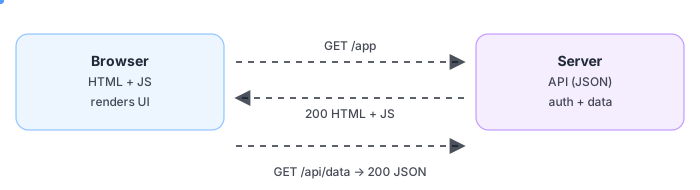
Rendering is how data becomes what the user sees. In web apps, the key question is: does the server send ready-to-display HTML, or does the browser build the UI from data?
Server returns HTML
Fast first paint
Browser renders from data
Very interactive
Both still use request → response.
The difference is what the response contains (HTML vs data).
Most real apps mix SSR and CSR.
Always: request + response, and a server boundary where validation + permissions belong.
The difference is what the response contains (HTML vs data), and where UI updates happen (server vs browser).
Request →
response
HTML
ready
Data
first
SSR vs CSR changes the response content, not the fundamentals.
Server boundary still exists (validation + permissions).
Choose per page: what makes the first view and interactions best?
SSR means the server returns fully formed HTML for a page.
SSR = response is HTML.
Pros: fast first paint, good for SEO, simple initial load.
Cons: interactions often still require requests (navigation or APIs).
CSR means the browser loads an HTML shell + JavaScript, then fetches data and renders UI dynamically.
CSR = browser renders UI from data (after loading JS).
Pros: highly interactive, fewer full page reloads.
Cons: more moving parts; needs a client framework + APIs.
IMPORTANT: No matter what you render, the server is where you protect data and enforce permissions.
Fast initial
HTML
Filters, forms
dashboards
Auth + rules
data safety
Common pattern: SSR for initial pages, CSR for interactive parts.
Even in CSR apps, the server still handles auth, validation, and data.
Pick per page/feature — it’s not an all-or-nothing decision.
NOTE: Wappler supports both styles — the key is to keep the server as the safe boundary for data + permissions.
First view
matters
Interactions
matter
Best of
both
Use SSR when the first view matters (landing pages, SEO, fast initial load).
Use CSR when the page is an app (dashboards, filters, live updates).
Use both when you want a fast first load and rich interactions.
You now know the rendering vocabulary: SSR renders HTML on the server; CSR renders UI in the browser (often after fetching JSON). Next, we’ll switch to the UI layer: Bootstrap basics for building page structure and layout.
Server
HTML
Browser
UI
Bootstrap
layout
SSR returns HTML; CSR renders in the browser.
Most apps mix both styles per page.
Next: build UI structure with Bootstrap.
Continue to Bootstrap Basics.